Friday, 31 July 2009

Hunterian Museum Glasgow


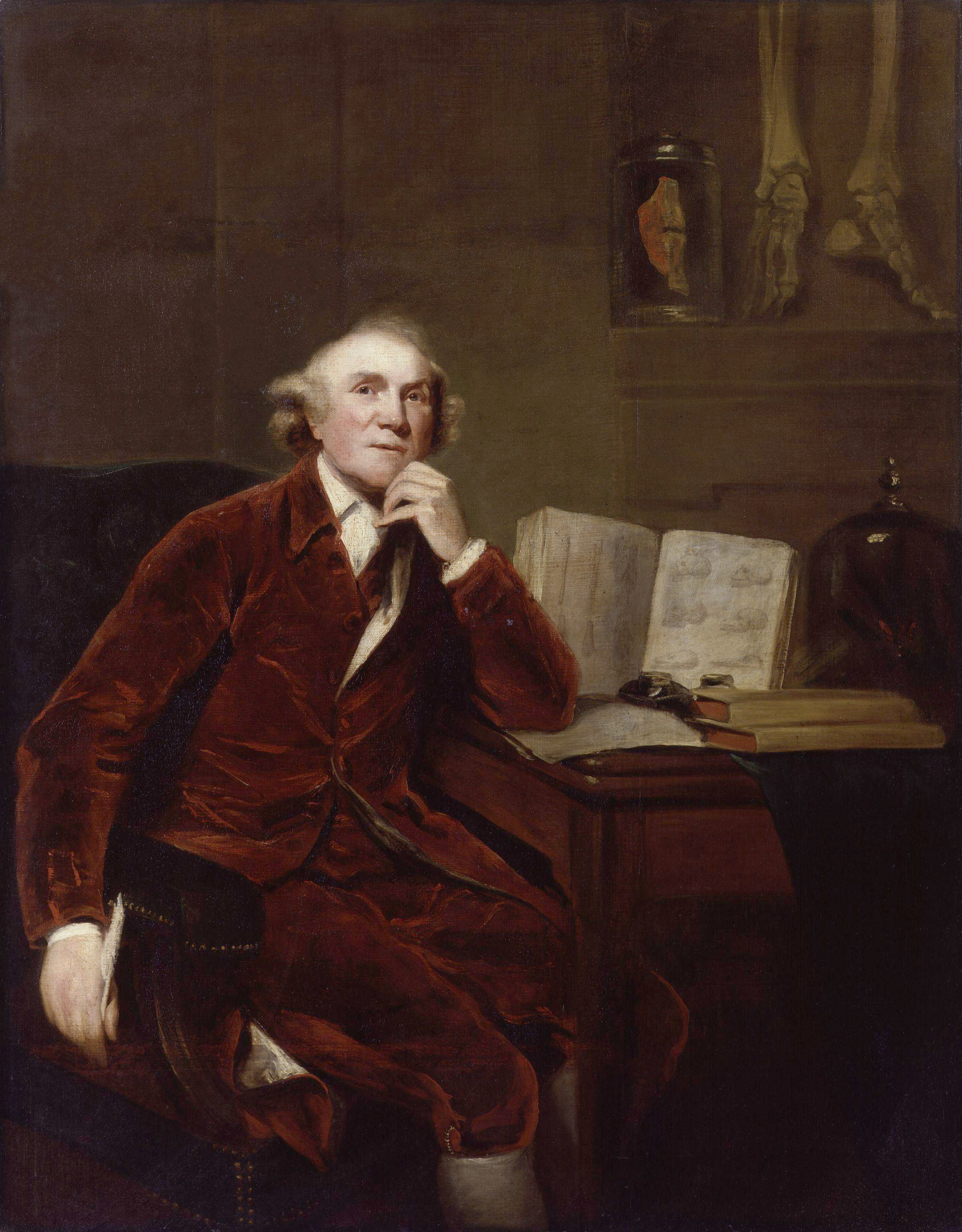
We finally made the trip to the Hunterian Museum in Glasgow University (after recently visiting The Hunter House Museum in East Kilbride) and it was fantastic! The Hunterian is the oldest public museum in Scotland. In 1783 William Hunter (1718-1783) donated an extensive and varied collection to the University of Glasgow. The Museum first opened in 1807 in a building off High Street, it moved to it's present location in 1870.

William's brother John (also a surgeon) founded his own museum in London, also known as 'The Hunterian Museum'. John's collection is most notable for his obtaining the skeleton of Charles Byrne's known as "The Irish Giant".


View the Flickr set here... Lot's of interesting specimens!

Hunterian Museum Glasgow

Pictures: the Museum and William Hunter's death mask.

Wednesday, 29 July 2009

Silhouettes


I first took note of the silhouette after visiting Monticello, the home of Thomas Jefferson, where the walls are lined with gorgeous silhouettes of him and his family.

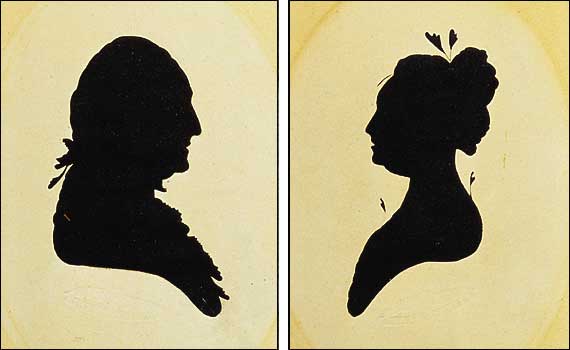
Silhouettes became extremely popular in the late 18th/early 19th century. It was an accessible portrait to the average person of the time. They were inexpensive and quickly produced.


The word 'silhouette' is derived from Etienne de Silhouette, who was the French Controller-General of Finances during the reign of Louis XV. He was considered particularly cheap, so the nickname given to these inexpensive paper cuttings was effectively meant to mock the man.

Silhouettes can be cut out of paper, hollow cut (cutting into the paper) or painted. Silhouettes were a fun past time for the rich and an affordable portrait for the working classes. Most cut silhouettes were cut in doubles: one for a frame (that would come with the picture) and one for the album. This is why you may find two of the same silhouette today in different locations. Painted silhouettes were usually achieved by mixing beer with pine soot and then painting it on ivory or plaster. One silhouette artist in particular, Mrs. Isabella Beetham, would use her finger to smudge the soot mixture onto the ivory. If you look at one of her paintings closely, thumb prints can be easily spotted in the images.
One of the most common silhouette artists to be found is John Miers, who had a studio on the Strand in London.

When the photograph came along the silhouette was all but obselete. It did see a revival in popularity in the early 20th century, but most of these were done by machine. There are still some silhouette artists today: you can book them for parties and weddings, and they can even be found at Disneyland. I find that there is just something so tasteful and intimate about a silhouette that a regular painted portrait just doesn't convey.

Top silhouettes are of Martha and George Washington and the bottom is an example of a Miers portrait.

Sunday, 26 July 2009

Uddingston


The above pictures are 'then and now' pictures of Uddingston, South Lanarkshire.

Recently my husband has come across this website and has been fascinated by it. It's so interesting to see how much or how little things have changed in an area as the years have gone by. It prompted me to take a couple pictures of the little Victorian coal mining town we live in.


Uddingston is mainly famous for two things: Bothwell Castle and Tunnocks. Tunnocks are notable for their incredible teacakes and the fact it has been a family-run business since it's humble beginnings in 1890. It boasts "more than 5,000,000 of these biscuits made and sold every week". Also, St. Andrews University has a Tunnocks Caramel Wafer Appreciation Society, which is one of the oldest student societies at the university.

I will cover Bothwell Castle in an upcoming post.


Thursday, 23 July 2009

Greyfriars Kirkyard

I mentioned Greyfriars in my last post on the Covenanters, and how it was used in the 17th c. as a prison for the men captured at the Battle of Bothwell Bridge. I decided that I would do a post on the rich history of Greyfriars Kirkyard itself.

Greyfriars is located in Edinburgh, Scotland. The kirk (church) opened in 1620. Greyfriars was witness to the Resurrectionsists (see entry on Mortsafes) that were roaming Scotland in the 18th and early 19th centuries. It resembles a zoo in some places, due to the tombs being barred up from precautions taken by the deceased's relatives in securing their graves from disturbance. Greyfriars was seen on a 2008 episode of the Sci-Fi Channel's 'Scariest Places on Earth'. There have been a number of deaths that have occured in the kirkyard, and it is reported to be extremely haunted. I found the yard to be serene and beautiful, but I suppose if you go looking for a scare, you'll find one.

Of course, Greyfriars is most famous for a little Skye terrier named 'Bobby':

"In 1858, a man named John Gray was buried in old Greyfriars Churchyard. His grave levelled by the hand of time, and unmarked by any stone, became scarcely discernible; but, although no human interest seemed to attach to it.

The sacred spot was not wholly disregarded or forgotten. For fourteen years the dead man's faithful dog kept constant watch and guard over the grave until his own death in 1872.

The famous Skye Terrier, Greyfriars Bobby was so devoted to his master John Gray, even in death, for fourteen years Bobby lay on the grave only leaving for food.

It is reported that a daily occurance of people from all walks of life would stand at the entrance of the Kirkyard waiting for the one o'clock gun and the appearance of Bobby leaving the grave for his midday meal." - GreyfriarsBobby.co.uk

Bobby is buried just inside the gates of Greyfriars.

All pictures taken by myself on my last visit to Greyfriars in May.

Wednesday, 22 July 2009

Buried heads & the Covenanters

A few weeks ago we were walking around Hamilton Old Parish Church and checking out the graveyard that surrounds the church, when we stumbled across a monument to The Covenanters. What made this monument particularly interesting was the fact that only the heads of these men are buried in the yard.

Covenanters were a group of Scottish civilians in the 17th century who wanted Presbyterianism recognised as the official form of church and not Episcopacy, which was favored by the crown. These people signed the National Covenant in 1638, hence the name 'Covenanters'. These people would not accept the King as the head of the church. Practicing Presbyterianism was an offence punishable by death. Many Covenanters were imprisoned in Greyfriars Kirkyard in Edinburgh. After the Battle of Bothwell bridge over 1200 prisoners were brought to Greyfriars and held in the chruch yard, where many of them died and were buried right in the cemetary where they parished.

Both of the pictures above were taken by myself the above is the Covenanter's marker in the church yard of Hamilton Old Parish Chruch and below is a close up of the Covenanter's memorial in Greyfriars Kirkyard.

Monday, 20 July 2009

Hunter House Museum & the Hunter brothers.


I finally managed to make it to the Hunter House Museum in East Kilbride, Lanarkshire (about a 15 minute drive from where I live). A few months ago I had read the book 'The Knife Man' by Wendy Moore. It was all about John Hunter and his incredible forward thinking in medicine, during a time when they were still practising Medieval procedures.

John hunter is famous for obtaining the corpse of the Irish giant Charles Byrne. Like most people in the 18th century, Byrne did not want his body going to an anatomist. So as to avoid this fate (which would have been a certainty given his proportions), his friends agreed to bury him in a lead coffin and dump it in the river Thames. John Hunter, however, managed to keep Byrne from his watery grave, and added his skeleton to his anatomical collection, which is now The Huntarian Museum in London. There is also a Huntarian Museum here in Glasgow at the University, but that collection was donated by John's elder brother William upon his death.


I would recommend reading the fantastic story of John Hunter: the man infected himself with syphilis in the name of science! He is truly the father of medicine as we know it today.

Friday, 17 July 2009

Spirit Photography & William H. Mumler

To expand upon my previous post about Lily Dale, I had mentioned something fascinating called "Spirit Photography".

Spirit photography is a form of physical mediumship and became popular in the later half of the 19th century. It was a photograph taken of a living person where the spirit of a deceased family member or friend would also be captured in the image.

William H. Mumler was the first spirit photographer, having taken a self portrait around 1860 that depicted the hazy apparition of his dead cousin in the background. There after, Mumler became a full time spirit photographer, which became a lucrative business as grieving families of causalities of the Civil War wanted reassurance that their family members would live on.

One of Mumler's most famous photographs was that of Mary Lincoln. The picture appears to show a foggy image of Abraham behind his widow, clad in black mourning attire.

Mumler, as you may have guessed by now, turned out to be a fraud. The method he used to achieve these photos was double exposure. It was discovered that some of the 'ghosts' in Mumler's photographs were in fact living people. Mumler was brought to trial in 1869 and died a pauper in 1884, his career being ruined.

The above photographs are of Fannie Conant, a well known Boston medium, pictured with her deceased brother Chas.
The next is of Mary Lincoln and her husband.